

Game selection starts after a Casino Mate action link opens the separate casino's live lobby. Australian players can make that choice manageable by deciding how long the session will last, choosing one visible category and opening only entries that fit the intended style of play. The live casino supplies the options for the visit, so the player works from the categories and titles that appear there.
INSTANT GAMES
View all











GAME SHOWS
View all












LIVE GAMES
View all













ROULETTE
View all





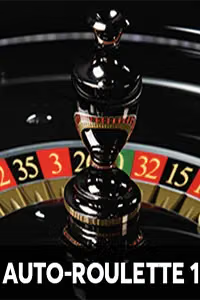
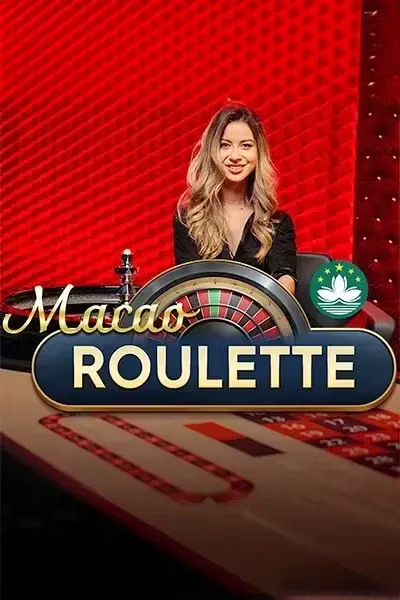
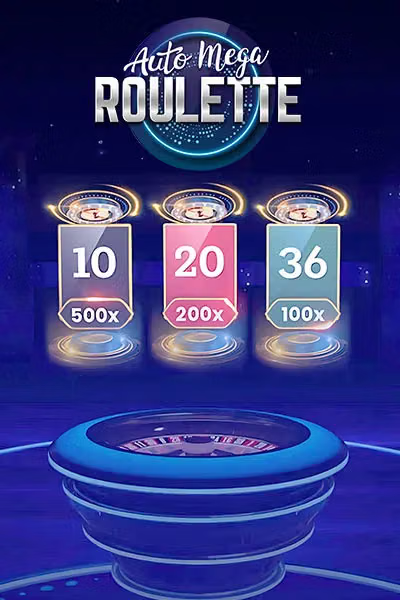




Set the session length before opening the lobby

A short session and a longer browse need different limits. Ten minutes spent looking for one familiar interaction is not the same as an evening set aside to compare several categories. Decide the time boundary first so the lobby does not turn into open-ended scrolling.
Use three questions:
- How much time has the player set aside?
- Is the aim a pokie, another casino format or simple category discovery?
- What event will end the browse: finding one suitable entry or reaching the time limit?
The answer creates a practical game-selection plan. A short visit suits one category and one or two candidates. A longer visit can include a measured contrast between different interaction styles, but it still benefits from a pre-set finish.
| Session plan | Lobby action | Natural stopping point |
|---|---|---|
| One quick choice | Open one visible category | One suitable entry is found or the player leaves |
| Category discovery | Compare labels at the live casino | One interaction family is selected |
| Longer browse | Contrast a small number of categories | The planned time expires |
| Account task | Leave game browsing | The player moves to the intended account action |
This approach does not assume that a particular category or listing is present. It simply gives the player a disciplined way to use the options in the live lobby.
Know when game choice becomes an account task
Game browsing ends when the immediate question concerns login, a promotion, a balance or a cashout. A game tile cannot answer an account question, so the player should pause the lobby and move to the relevant account area.
Use a clean transition:
- Finish or leave the selection already open.
- Return to the intended casino account context.
- Complete the promotion, access or cashier action once.
- Re-enter the lobby only when game selection becomes the purpose again.
The cashout workflow is a clear example. It begins with the intended account, its cashier, a visible destination and one request. Game labels have no role in that sequence.
The same boundary helps with the welcome offer. Second Strike is the sole named game in the documented spin component, but account eligibility and stage selection remain promotion decisions rather than lobby filters.
Use the phone screen to narrow one category
A phone exposes less lobby information at once, which makes one-category browsing more comfortable than jumping across several rows. Open the live casino, keep one category heading in context and compare only the entries visible within that group.
For a compact session:
- choose one category that matches the intended interaction;
- retain no more than two candidates;
- read the game identity and main interaction before opening play;
- leave the category when neither option fits the plan.
The player does not need to map the full catalogue. The goal is one suitable choice for this visit. A wider screen can help when category labels or several option panels need to be read together, but changing screens does not change the session limit.
Touch comfort also matters. An entry that feels crowded or hard to leave on the phone is a poor fit for that device even when its theme looks appealing. The live game surface provides the answer.
Separate pokies from table and wheel play

Pokies are reel-led games in Australian casino language. A player choosing reels uses the pokie catalogue approach to separate ordinary browsing from the named Second Strike welcome-spin use.
Table and wheel formats use different decision rhythms. A table choice centres on repeated decisions within the game, while a wheel-led format centres on a recurring event cycle. When either family appears in the live lobby, the interaction style helps the player decide whether it fits the session.
| Interaction family | Main player focus | Session question |
|---|---|---|
| Pokie | Reels, symbols and feature cues | Does this reel-led option suit the planned attention? |
| Table format | Repeated game decisions | Does this decision rhythm fit the session? |
| Wheel-led format | A recurring event cycle | Does this pace match the player's preference? |
The player uses the labels actually visible in the casino. When the intended family is absent, the sensible choice is to select another visible option or leave, not to infer a hidden catalogue.
Treat provider, hosted and free-play labels as optional filters
For the player, provider, hosted and free-play wording matters only when it appears beside a live category or entry. These labels refine an existing game choice and retain the scope of the entry carrying them.
A provider label identifies the name associated with that specific listing. It does not prove game quality, inventory size or the presence of other games. A hosted label can distinguish a presentation style when the casino uses it. A free-play control applies to the entry carrying that control and should not be extended across the lobby.
Use optional labels in this order:
- Choose the visible category that fits the intended interaction.
- Narrow the live entries to a small set.
- Read provider, hosted or free-play wording attached to those entries.
- Use the label only for the decision it directly supports.
This keeps labels subordinate to the player's time, category and play preference. It also avoids turning one observable tag into a claim about every game in the lobby.
Frequently asked questions
What is the quickest way to narrow a live game choice?
Set a session length, choose one category visible in the live lobby and compare only one or two entries within it.
Where do pokies fit in the wider game choice?
Pokies fit a reel-led session built around symbols, spin controls and feature cues. Other interaction types call for a different category decision.
What can a provider label tell me?
It identifies the provider name attached to that live entry. It does not establish a wider game inventory or guarantee quality.
What does a free-play control change?
When a live entry includes one, the control applies to that entry. It should not be treated as a promise for every game in the lobby.
How do hosted and digital labels affect table choice?
Where those words appear, they can distinguish presentation styles for the specific live choice. The player still bases the decision on the interaction and time planned.
When is it time to leave game browsing?
Leave when the time limit arrives, one suitable entry has been found or the next action concerns the account, promotion or cashier.